I fly the Airbus A320 family for a living, and I can tell you something that surprises a lot of passengers: the A320 is a noisy, chatty aeroplane, and almost every sound it makes is completely normal. Pumps start and stop, panels move, air is switched from one place to another. If you are living with flight anxiety, those sounds can feel like warnings. Once you know what they are, they become a running commentary that says "everything is working".
This page walks through a normal flight on an A320, A319, A321 or the newer "neo" versions, in the order you'll hear things. If you want a general version that applies to most airliners, see every normal plane noise, gate to gate. For a printable version to keep in your bag, grab my free guide.
Quick reference: A320 sounds in flight order
| When | What you hear or feel | What it is |
|---|---|---|
| Boarding | Steady whine from the tail, rush of air | APU and air conditioning packs |
| Boarding | Hum under the floor, cargo doors moving | Electric hydraulic pump for the cargo doors |
| Engine start | Air goes quiet, cabin a little warmer | Packs pause so air can start the engine |
| Engine start | Rising whine, then a steady hum | Engine spooling up |
| Engine start / taxi | Loud "brrt-brrt", like a barking dog | Hydraulic Power Transfer Unit (PTU) |
| Engine start | Lights flicker for a moment | Power switching from the APU to the engines |
| Taxi | Whirring from the wings | Slats and flaps extending |
| Taxi | Panels on the wings flicking up and down | Pilots checking the flight controls |
| Take-off | Big roar, pushed back in your seat | Take-off thrust |
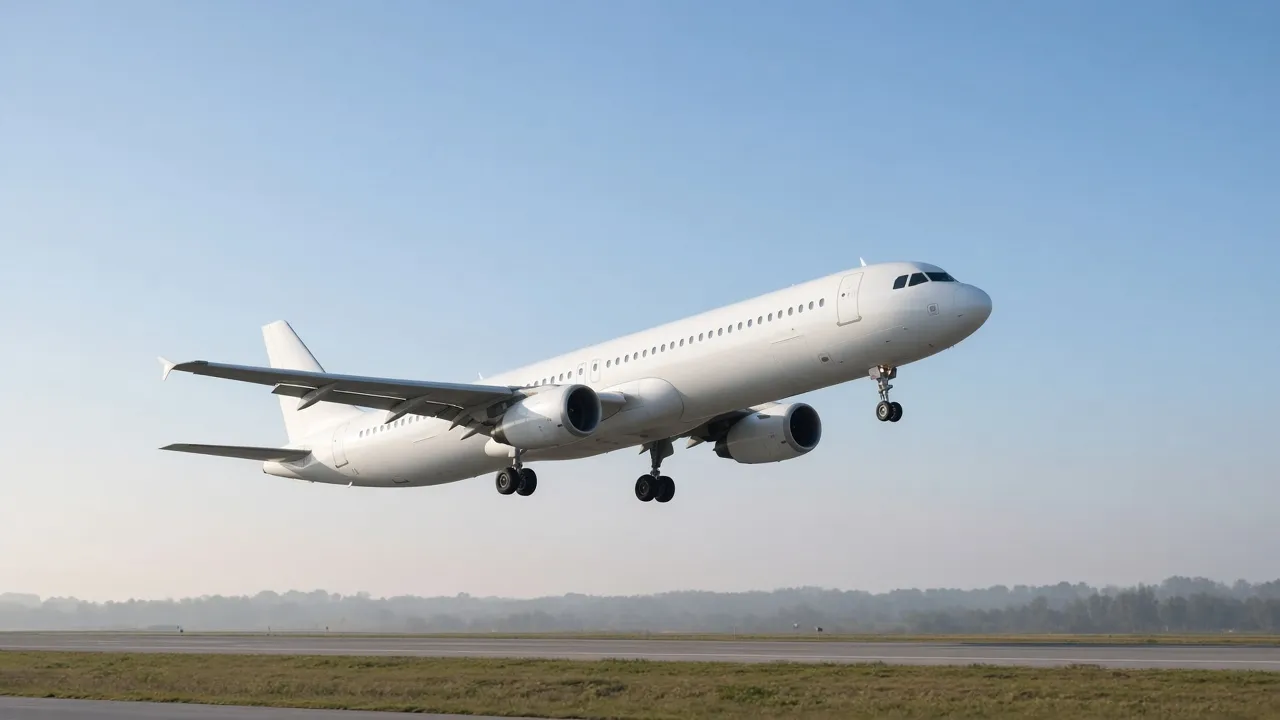
| After lift-off | Rumble, then a thud | Landing gear retracting, doors closing |
| First minutes of climb | Engines go noticeably quieter | Thrust reduced to climb setting |
| Climb | Whirring, gentle sinking feeling | Flaps and slats retracting |
| Climb / cruise | Chimes | Crew communication, seatbelt sign |
| Cruise | Small changes in engine note | Autothrust holding the speed |
| Descent | Engines very quiet | Idle thrust, a planned glide |
| Descent | Rumble and light vibration | Speedbrakes on top of the wings |
| Approach | Whirring, more wind noise | Slats and flaps extending in stages |
| Approach | Loud rumble and clunk | Landing gear coming down |
| Touchdown | Panels pop up on the wings | Ground spoilers |
| After touchdown | Big roar | Reverse thrust |
| Taxi in | Barking dog again | PTU, often with one engine shut down |
At the gate
A steady whine from the back of the aircraft. In the tail cone of every A320 there is a small jet engine called the APU, or auxiliary power unit. On the ground it supplies electricity and compressed air for the air conditioning. If you board by stairs at the back, you'll hear it clearly. It is meant to be running.
A constant rush of air. The A320 has two air conditioning "packs" in the belly, between the wings. They take hot compressed air, cool it and feed it into the cabin. That gentle roar from the vents is them. On a hot day the cabin can feel warm until the packs catch up.
Hums and thumps under your feet. Bags and containers are loaded into the holds below you. On the A320 the cargo doors are moved by a hydraulic system, and on the ground an electric pump powers it. You may hear an electric hum, then thuds as the doors open and close. Nothing to do with the flight itself.
The doors close and the crew arm the slides. A firm clunk as the main doors close, then the announcement to arm doors and cross-check. This connects the emergency slides so they would deploy if a door were opened in an emergency. It happens on every flight.
Pushback and engine start
The air goes quiet. When the pilots start an engine, the packs pause automatically. Starting a jet engine needs a strong flow of compressed air from the APU, and the A320 sends that air to the engine starter instead of the cabin. For a minute or so the vents go quiet and the cabin may feel a little warmer. Then the air returns.
A rising whine, then a steady hum. That is the engine spooling up and settling at idle. On many A320s you'll hear one engine start during or just after pushback, and the second a little later.
The barking dog. This is the sound that worries more A320 passengers than any other: a loud, repeating "brrt... brrt... brrt" from somewhere under the floor. It is the Power Transfer Unit (PTU).
Here is what is happening. The A320 has three independent hydraulic systems, which pilots call green, blue and yellow. They power the flight controls, the landing gear, the brakes and more. Each engine drives a pump for one of them. When only one engine is running, the two systems can end up at very different pressures, and the PTU automatically transfers power between them, without mixing any fluid. As it starts, stops and starts again, it makes that bark.
You'll most often hear it around the second engine start, when it is also checked automatically, and whenever the crew taxi on one engine to save fuel. It is not a fault. It is a backup system doing exactly what it was designed to do. When I hear it, I hear redundancy.
The lights flicker. Once the engines are running, their generators take over the electrical supply from the APU. That handover can make the lights flicker or the screens blink for a moment. Normal.
Taxi
A whirring from the wings. Before take-off we extend the slats on the front of the wing and the flaps on the back. Hydraulic motors drive them through long shafts that run along each wing, and you'll hear a steady whir and see the wing change shape if you're by a window.
Panels flicking up and down. At some point during taxi the pilots move the sidestick and rudder through their full range to check the flight controls. From a window seat you may see the ailerons and the panels on top of the wing move up and down, and you may hear a brief hydraulic whine. That is a check we do before every flight.
Bumps, rumbles and the odd squeak. Taxiways have joints and centreline lights, and the nose wheel rolls over them. Gentle braking can make a squeak or a hiss.
Chimes. You'll hear chimes all through the flight. On the A320, different tones mean different things, such as a passenger call button or the crew calling each other on the interphone. Pilots usually chime the cabin to let the crew know take-off is close. A chime is a message, not an alarm.
Take-off
The roar. The pilots set take-off thrust and the engines wind up together. You're pushed back in your seat and the runway rumble builds. Very often we use a reduced take-off thrust calculated for that day's weight, runway and weather. It is gentler on the engines and still gives us all the performance we need.
The rumble stops. As the nose lifts and the wheels leave the runway, the rumbling stops. Some people find the sudden smoothness strange. It simply means we are flying.
A rumble and a thud a few seconds later. We raise the landing gear once we are climbing. The main gear folds inward into the belly, the nose gear folds forward, and the doors close behind them with a thud. The main wheels are braked automatically as they retract, so they stop spinning before they go into the bay. You might feel a brief shudder as that happens. The cabin usually gets a little quieter afterwards, because the wheels are no longer out in the airflow.
The first few minutes
The engines go quiet. This is the sensation I'm asked about most. A minute or two after take-off, at a planned height above the airport, the pilots bring the thrust levers back from the take-off setting to the climb setting. The engine note drops and you may feel as if the aircraft is slowing or sinking. It isn't. The aircraft is still climbing, just less steeply. We do this on every flight, partly to reduce noise for people living near the airport and partly to save wear on the engines.
More whirring, and a gentle sinking feeling. As the speed builds we retract the flaps and slats in stages. The wing becomes slimmer and the aircraft lowers its nose slightly to keep accelerating. For a few seconds you may feel a little lighter in your seat. That is the wing changing shape, exactly as planned.
Turns. Shortly after take-off, the aircraft often turns onto its departure route. A turn can feel steeper than it is when you can only see the sky or the ground out of one window.
Climb and cruise
Chimes and the seatbelt sign. Passing around 10,000 feet you'll often hear a chime, and the seatbelt sign may go off when conditions are smooth. My advice is to keep your belt loosely fastened whenever you're in your seat anyway.
Ears popping. The cabin is pressurised gradually as we climb. Swallow, yawn or chew to help your ears adjust.
Small changes in engine sound. In cruise the autothrust system makes small, constant adjustments to hold the planned speed. You'll hear the engines rise and fall slightly, especially in light turbulence. That is fine-tuning, not a problem.
Bumps. Turbulence is air moving unevenly, like a boat crossing small waves. A bump that feels like a big drop is usually just a bit of altitude lost; on the flight deck we barely see it on the instruments. If it gets bumpy, the crew may sit down with their belts on. That is a precaution to stop people and trolleys moving around, not a sign of danger. I explain this fully in is turbulence dangerous? and why does the plane suddenly drop?.
Galley and toilet noises. Trolleys being locked, oven doors closing and the loud vacuum toilet flush are all part of a normal flight.
Descent
The engines go very quiet. At the top of descent the engines often go back to idle and the aircraft descends on a smooth, planned path. A quiet cabin at this point is exactly what we intended. Pilots call it "idle descent", and it saves fuel.
A rumble and light vibration through the floor. To descend more steeply or slow down, we may use the speedbrakes, which are panels that rise on top of each wing. They disturb the airflow, so you feel a light buffeting and hear a low rumble. When we stow them, it stops.
Ears again. As the cabin pressure increases, your ears may feel blocked. Swallow, yawn, or gently pinch your nose and blow.
Approach
Whirring as the wing changes shape again. We extend the slats and flaps in stages as we slow down. Each stage brings a whir and a small change in how the aircraft feels, sometimes a slight lift or a nose-down change in attitude.
A loud rumble and a clunk. The landing gear comes down and locks, usually several miles before the runway. It is noisy, because the wheels and doors are now in the airflow, and the engines may increase power a little to make up for the extra drag.
Engines rising and falling in small steps. On final approach the autothrust adjusts power continuously to hold an exact speed. On a gusty day you'll hear it working harder. That's the system doing its job.
Touchdown and rollout
A firm touch. Sometimes we land firmly on purpose, especially on a wet or shorter runway, to get the wheels gripping straight away. A firm landing is not a bad landing.
Panels pop up on the wings. At touchdown the ground spoilers deploy automatically. They stop the wings producing lift, which puts the aircraft's weight on the wheels so the brakes work well. You may feel the aircraft settle.
A big roar. Straight after touchdown the engines get loud again. That is reverse thrust, which redirects the engine airflow forward to help slow down, together with the automatic brakes. As we slow, the noise dies away. Sometimes we use only a small amount of reverse thrust, so this roar can be louder on some flights than others.
Taxi to the gate
The barking dog returns. To save fuel we often shut down one engine while taxiing in, and the PTU may bark again for the same reason as before.
A new whine from the tail. The APU is usually started again before we park, so the cabin keeps power and air conditioning once the engines are off. When power switches back over, the lights may flicker once more.
The final chime. Once we're parked and the engines have stopped, the seatbelt sign goes off with a chime and the crew disarm the doors.
Why naming the sounds works
Flight anxiety feeds on the unknown. When you hear something you can't explain, your brain assumes the worst and turns up your body's alarm system. When you can name a sound ("that's the PTU", "that's climb thrust", "that's the gear"), the alarm has nothing to react to.
On your next A320 flight, try naming each sound quietly as it happens. If you notice your breathing speeding up, slow it down: breathe in gently for a count of five and out for a count of five, and keep going for a few minutes. There's more on that in my breathing techniques for flight anxiety.
A captain's note on what pilots listen for
Pilots don't judge the aircraft's health by ear. The A320 monitors its own systems continuously and shows us anything that needs attention long before you would hear it in the cabin, and we practise every procedure in the simulator twice a year. So when you hear something unfamiliar, it is far more likely to be one of the normal sounds on this page than anything else.
The captain's bottom line
The A320 talks a lot. The bark, the whir, the thud and the sudden quiet are the sounds of an aircraft doing exactly what it was designed to do. Learn them once, and they'll become part of the rhythm of every flight you take.
Want this in your pocket?
Download my free illustrated PDF, Turbulence & Aircraft Sounds Explained by an Airline Captain, and take it on your next flight.
Get the free guideFrequently asked questions
What is the barking dog noise on an A320?
It is the Power Transfer Unit (PTU), a hydraulic pump that links two of the A320's three hydraulic systems. It runs automatically when one system has much less pressure than the other, which is normal around engine start and when the crew taxi on one engine. It sounds dramatic, but it is a pump doing its job.
Why does the A320 go quiet a minute or two after take-off?
The pilots move the thrust levers from the take-off setting back to the climb setting at a planned height. The engines get quieter and you may feel a slight sinking sensation, but the aircraft is still climbing.
What is the loud rumble and thud after take-off on an A320?
That is the landing gear retracting into the belly and the gear doors closing behind it. The main wheels are braked automatically as they come up, so they stop spinning before they go into the bay.
What are the panels that pop up on the wings after landing?
They are the ground spoilers. They deploy automatically at touchdown to stop the wings producing lift, which puts the aircraft's weight on the wheels so the brakes work well. In flight, some of the same panels are used as speedbrakes.
Why does the air conditioning stop during engine start?
On the A320 the air conditioning packs pause automatically while an engine starts, so the compressed air goes to the engine starter. The air comes back on a minute or so later. The cabin may feel a little warmer or quieter in the meantime.
This article is general information, not medical or professional advice. Always follow instructions from your crew. If fear of flying seriously affects your life, please speak to a doctor or qualified therapist.