If you have ever gripped an armrest while your coffee danced across the tray table, you are in very good company. Turbulence is the single most common reason people tell me they are scared of flying. So let's talk about it honestly, the way I would if you were sitting next to me on the jump seat.
The short answer: turbulence is uncomfortable, but for a modern airliner it is not dangerous. The longer answer is worth knowing, because once you understand what is happening outside the window, the bumps start to feel very different.
What turbulence actually is
Air is a fluid, just like water. It flows, it swirls, it speeds up and slows down. When an aircraft flies through air that is moving unevenly, the wings meet slightly different airflow from one moment to the next, and the aircraft moves a little up, down or sideways. That movement is turbulence.
Think of a boat crossing a lake. On a still morning, the water is glassy and the ride is smooth. In the afternoon, when the wind picks up, the boat starts to rock over small waves. Nobody on that boat thinks it is about to sink. It is simply moving through water that is not perfectly flat. Air is the same, except we cannot see the waves.
The most common causes are:
- Rising warm air (convection). On sunny days, the ground heats the air above it, which rises in bubbles. Flying low through those bubbles on a summer afternoon produces the classic light, choppy ride.
- Wind over terrain. When strong wind flows over mountains, it tumbles on the other side like water over rocks in a stream. This is called mountain wave.
- Jet streams and wind shear. High up, there are rivers of fast-moving air. Where fast air meets slower air, it creates ripples. This is what people call clear-air turbulence, because there are often no clouds to warn you.
- Weather. Thunderstorms produce strong vertical currents. This is the one type pilots actively avoid by a wide margin, which I explain further down.
- Wake turbulence. Every aircraft leaves a swirl of air behind it. Air traffic control keeps aircraft spaced apart so this is rarely noticeable.
Why it feels so much worse than it is
Here is something that surprises many passengers. A bump that feels like the aircraft "dropped" a long way is almost always a change in height of a few metres, often less. On the flight deck, we see it on our instruments, and the altitude needle barely moves.
Why the gap between feeling and reality? Your body is wired to notice vertical movement. The fluid in your inner ear and the sensation in your stomach are very good at detecting small changes in acceleration, but very bad at judging distance. Add a cabin with no clear view of the horizon, the sound of the engines changing slightly, and a mind that is already on alert, and your brain fills the gap with the worst-case story.
When you know that the "big drop" was really a few metres in a sky that is thousands of metres deep, the story starts to lose its power.
How strong is an airliner, really?
Airliners are designed and tested to take loads far beyond what they meet in daily flying. During certification, wings are bent in test rigs until they reach their design limits, and then beyond, to prove they have a large safety margin. You may have seen videos of wings being flexed upward dramatically in a hangar test. That flexibility is deliberate. A wing that bends is a wing that absorbs energy, like the suspension on a car.
So when you look out of the window and see the wingtip moving up and down in turbulence, that is not a sign of stress. That is the wing doing exactly what its engineers designed it to do.
In my career I have flown turboprops, narrowbody jets and large widebody aircraft across many different climates, from tropical thunderstorm season to winter jet streams. I have flown through a lot of bumpy air. The aircraft has never been the thing I worried about. My focus in turbulence is passenger and crew comfort, and making sure everyone is seated.
The real risk, and how to remove it
If turbulence does not threaten the aircraft, why do we take it seriously? Because of people who are not strapped in.
Safety investigators such as the US National Transportation Safety Board have found that turbulence is one of the leading causes of injuries on large airliners, and that the people most often hurt are flight attendants, who have to be on their feet doing their job, and passengers who were not wearing their seatbelt. You can read the NTSB's own research on this in its >safety research report on preventing turbulence-related injuries.
That gives you an extremely simple, extremely powerful habit:
Whenever you are in your seat, keep your belt fastened, loosely if you like, even when the sign is off.
That's it. That single habit takes away almost all of the real-world risk of turbulence. Pilots do exactly the same thing. Our belts stay on the whole flight.
Light, moderate, severe: what the words mean
Pilots describe turbulence in categories, and it helps to know them:
- Light: slight, erratic changes. Drinks may ripple. Walking is still possible. This is by far the most common.
- Moderate: you feel definite strain against your seatbelt. Walking is difficult, and the crew will usually be asked to sit down. Unsecured items may move.
- Severe: large, abrupt changes. Loose items can be thrown about. This is rare, and pilots work hard, using forecasts and reports, to avoid it.
Most passengers who describe a flight as "terrible turbulence" experienced light to moderate turbulence. Uncomfortable, yes. Dangerous to a belted passenger, no.
How pilots avoid the bumps in the first place
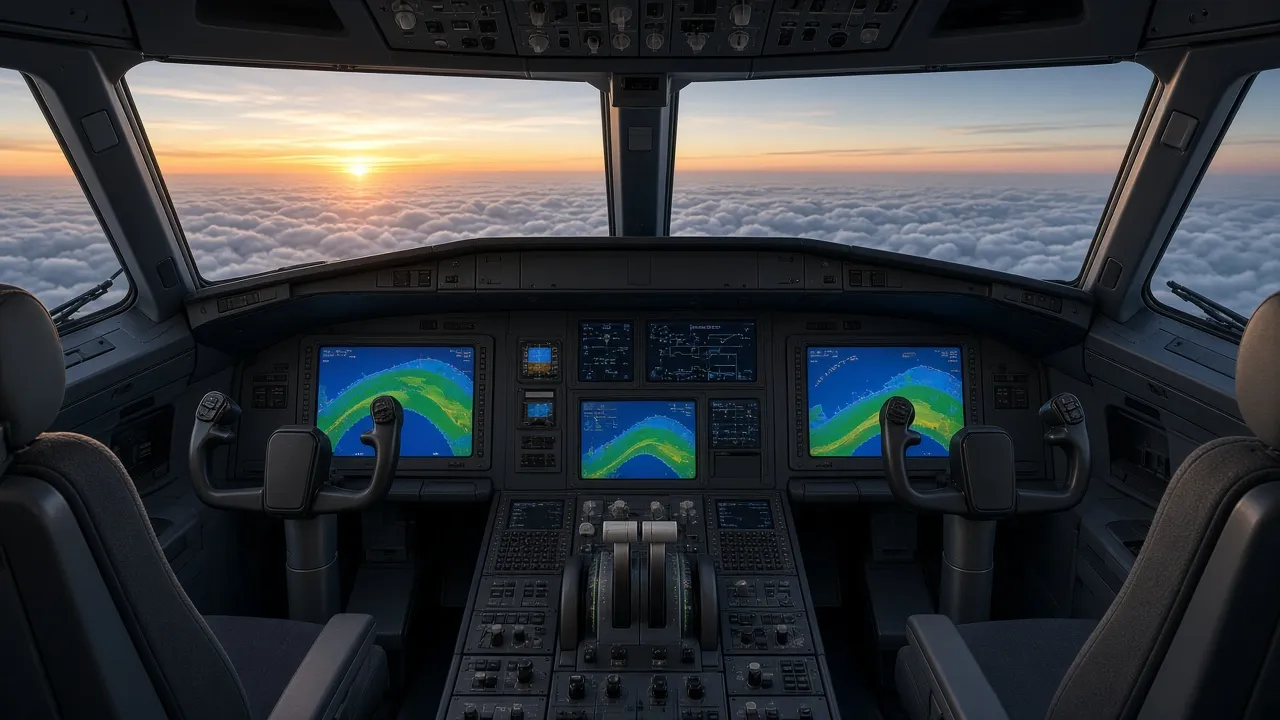
Long before you board, the crew have looked at weather charts showing forecast turbulence, jet streams and storm areas. In flight, we listen to reports from aircraft ahead of us on the same route, and we share our own. If the ride is bumpy at one altitude, we often ask air traffic control to climb or descend to find smoother air. Weather radar shows us storm cells so we can steer around them by many miles.
I have written a separate article on how pilots handle turbulence if you would like to see the step-by-step routine from the flight deck.
What you can do when it gets bumpy
- Belt on, feet flat, shoulders down. Relax into the seat rather than bracing against it. A tense body feels every bump more sharply.
- Breathe out slowly. Make your out-breath longer than your in-breath, for example in for four, out for six. This tells your nervous system that you are safe. My guide to breathing techniques for flying anxiety goes deeper.
- Watch the cabin crew. If they are calm and chatting, the flight deck has told them what to expect. Crews are briefed before every flight about where the bumps are likely.
- Use the water-glass trick. Put a cup of water on your tray table and watch it. You will often see it barely ripple while your body tells you the aircraft is lurching. It is a great reality check.
- Choose your seat. Seats over the wing usually feel the smoothest ride. More on that in the best seats for nervous flyers.
- Name it. Say quietly to yourself, "This is turbulence. It is uncomfortable, not dangerous. It will pass." Naming a feeling reduces its grip.
A word about the headlines
Occasionally you will read a news story about a severe turbulence encounter where people were injured. These stories are real and they matter, but they are news precisely because they are rare compared with the tens of millions of flights operated every year. In almost every reported case, the people hurt were not wearing a seatbelt at the moment it happened. The aircraft landed safely.
The lesson is not "turbulence is dangerous." The lesson is "wear your seatbelt."
The captain's bottom line
Turbulence is the sky being the sky. It is weather, it is wind, it is the air moving the way air always has. Your aircraft is built for it, your pilots plan for it, and you can make yourself almost completely safe with a fastened belt.
The next time the seatbelt sign comes on with that gentle chime, I'd like you to picture what is happening on the flight deck: two pilots, calm, coffee in a holder, maybe asking for a different altitude, maybe simply waiting a few minutes for smoother air. That is what turbulence looks like from the front.
If you'd like a printable version of this, plus every normal noise you will hear from gate to gate, grab my free guide, Turbulence & Aircraft Sounds Explained by an Airline Captain.
Want this in your pocket?
Download my free illustrated PDF, Turbulence & Aircraft Sounds Explained by an Airline Captain, and take it on your next flight.
Get the free guideFrequently asked questions
Can turbulence make a plane crash?
For modern airliners in normal operation, turbulence is a comfort issue, not a structural one. Aircraft are certified to withstand loads well beyond anything they meet in everyday turbulence, and pilots actively avoid the worst areas.
Why does turbulence feel so much worse than it is?
Your inner ear and stomach are very sensitive to small vertical movements, and in a seat with no view outside your brain fills in the gaps with worst-case guesses. What feels like a big drop is usually a change of a few metres.
What is the safest thing I can do in turbulence?
Keep your seatbelt fastened whenever you are seated, even when the sign is off. Almost all turbulence injuries happen to people who are not strapped in.
This article is general information, not medical or professional advice. Always follow instructions from your crew. If fear of flying seriously affects your life, please speak to a doctor or qualified therapist.