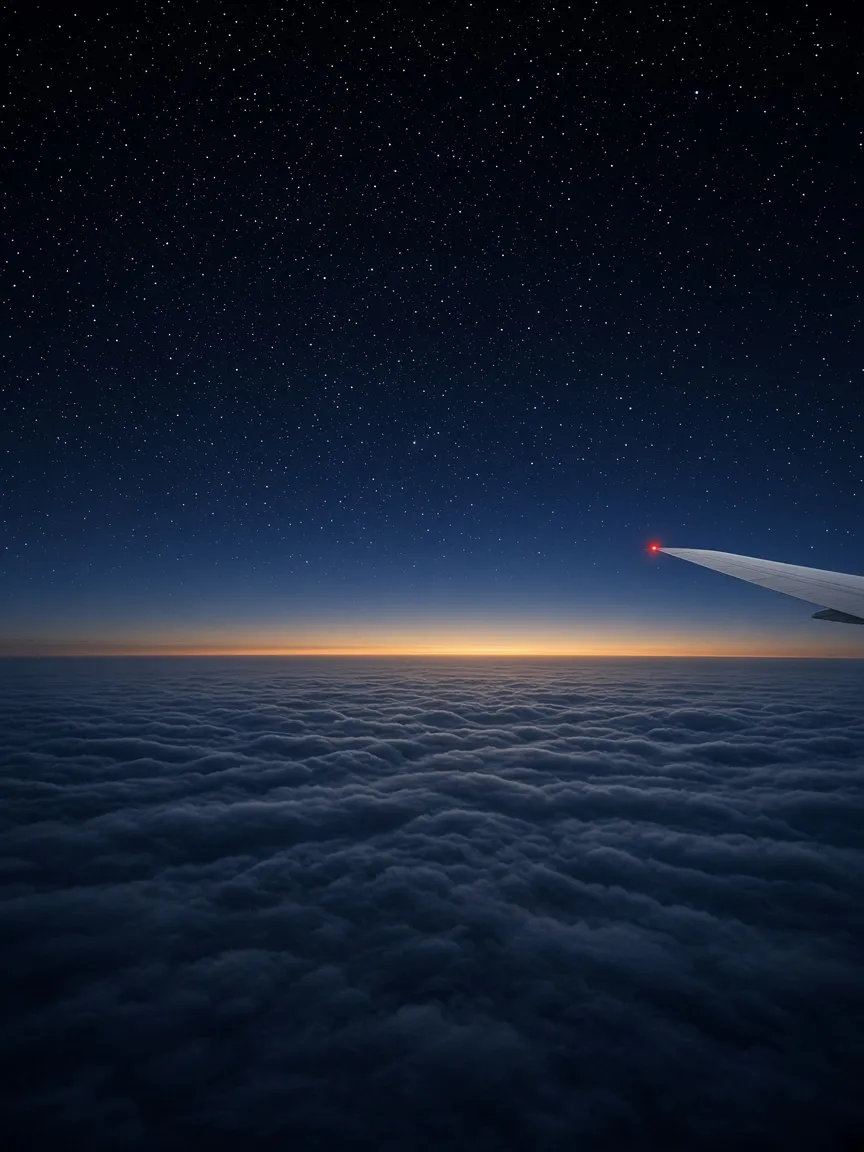
For many people with flight anxiety, the hardest part of a long trip isn't take-off or landing. It's the hours in the middle, with nothing but dark water below. "What if something happens out here, so far from anywhere?"
I've spent years on long-haul routes, including many ocean crossings at night. Here's what is going on behind the flight deck door, and why the ocean is a far less lonely place for an aircraft than it looks.
Over-water flights are planned in detail
Before any ocean crossing, the route is planned with the weather, the winds and the alternate airports along the way. For long crossings, aircraft often fly on organised routes that are planned each day around the jet streams, with every aircraft given its own track, altitude and speed. Air traffic control keeps aircraft safely separated the whole way, even where there is no radar.
Extra rules for twin-engine jets
Most long over-water flights today are flown on twin-engine jets. They operate under special rules, often called ETOPS or EDTO, that only approve an aircraft and an airline for these routes after extra checks. In simple terms:
- The route is planned so the aircraft always stays within a set flying time of a suitable airport where it could land if needed.
- The aircraft has to meet extra reliability and equipment standards.
- Maintenance and crews follow additional procedures before and during these flights.
Twin-engine airliners are designed to fly safely on one engine, and these rules add another layer of planning on top. I explain engine reliability in what happens if an engine fails?.
You are never out of contact
Over the ocean, beyond the range of normal radio, pilots use satellite communication, datalink messages and long-range radio. The aircraft's position is reported along the route, and we can talk to air traffic control and our company when we need to. Airliners also normally keep a listening watch on a shared emergency frequency, so other aircraft are effectively "around" you even in the middle of an ocean.
It's often the smoothest part of the trip
Turbulence depends on weather and jet streams, not on what is below. Many ocean crossings, especially at night, are smooth for hours. If it does get bumpy, it's the same air and the same aircraft as anywhere else. A bump that feels like a big drop is usually just a bit of altitude lost. If that sinking feeling is your trigger, read why does the plane suddenly drop?.
The things that help over water
Stop watching the map. The moving map can turn every minute into a countdown. Try checking it once an hour, not every five minutes.
Break the flight into chunks. A meal, a film, a sleep, a walk to stretch. Each chunk is a small win. My long-haul flight anxiety plan has an hour-by-hour version.
Keep your body calm. Slow breathing works anywhere: in for a count of five, out for a count of five, for a few minutes at a time.
Learn the sounds before you go. Engines adjusting, chimes and galley noises are all normal. My A320 sounds and sensations guide and every normal plane noise explain them.
Know the life vest is a precaution. The safety demonstration includes life vests on over-water flights because airlines prepare for every possibility, not because anyone expects to need them.
The captain's bottom line
Over the ocean, your flight is planned, tracked, connected and governed by extra rules designed for exactly this kind of route. The water below looks empty, but the system around your aircraft never switches off. For a calm companion on your next long flight, download my free guide.
Want this in your pocket?
Download my free illustrated PDF, Turbulence & Aircraft Sounds Explained by an Airline Captain, and take it on your next flight.
Get the free guideFrequently asked questions
Is it safe to fly over the ocean?
Yes. Over-water flights follow the same high safety standards as any other flight, plus extra planning. Twin-engine jets on long over-water routes operate under special rules that keep them within a set flying time of a suitable airport.
Can pilots talk to anyone over the middle of the ocean?
Yes. Out of range of normal radio, pilots use satellite communication, datalink messages and long-range radio, and the aircraft's position is reported along the route.
Is turbulence worse over the ocean?
Not necessarily. Turbulence depends on the weather and jet streams, not on whether there is water below. Some ocean crossings are among the smoothest parts of a long flight.
This article is general information, not medical or professional advice. Always follow instructions from your crew. If fear of flying seriously affects your life, please speak to a doctor or qualified therapist.